
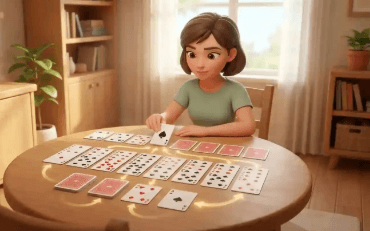
FreeCell looks simple because its rules are easy to understand and most of the cards are visible from the start. The real challenge appears when several possible moves compete for the same limited spaces. Learning to spot useful patterns, recognize blocked cards, and reconsider an early decision can turn an ordinary FreeCell session into a practical exercise in organized thinking.
Start by Looking, Not Moving
One of the easiest habits to develop in FreeCell is also one of the most useful: take a moment to look at the entire layout before touching a card.
A standard FreeCell game uses 52 cards distributed across eight tableau columns, with four free cells and four foundation piles. Because most of the cards are already visible, there is usually enough information on the board to identify several possible directions before making the first move.
Instead of immediately moving an available card, scan the tableau for Aces, low cards, blocked sequences, and columns that could potentially be cleared. This simple observation step can prevent an early move from limiting better possibilities later.
Think in Terms of Space
Free Cell is not only about the cards. It is also about where those cards can go.
The four free cells provide temporary storage for individual cards, while an empty tableau column can provide considerably more room for rearranging the layout. Managing these spaces is therefore an important part of keeping options available.
A useful question before using a free cell is: “What does this space help me accomplish?”
If placing a card there allows another card to become accessible, the move may serve a clear purpose. If it simply removes one card from the tableau without creating another opportunity, keeping the space open may be more useful.
Thinking about space in this way changes how the board looks. Empty areas stop being passive parts of the layout and become resources that can influence what is possible next.
Find the Card Behind the Problem
Sometimes the most important card on the board is not the one you can move immediately.
A card buried underneath several other cards may be needed to continue a sequence or reach a foundation. In that situation, the real objective is not necessarily to move the visible card on top. It is to determine how the cards above it can be reorganized.
This is where FreeCell becomes more interesting than its simple rules suggest.
Imagine an important low card sitting underneath a larger sequence. Clearing that sequence may require several smaller moves involving different columns and one or more free cells. The player is effectively working backward from an obstacle to determine which actions can remove it.
That way of looking at the tableau encourages players to identify what is preventing progress, rather than simply searching for any legal move.
Give Every Move a Purpose
A legal move is not automatically a useful move.
FreeCell allows players to make many moves that follow the rules but do little to improve the position. Moving a card simply because it can move may eventually leave important spaces occupied or useful sequences unavailable.
A stronger habit is to give significant moves a specific purpose. A move might uncover a hidden part of a sequence, create an empty column, free a useful card, build toward a foundation, or improve the arrangement of the tableau.
This does not mean every move needs a complicated explanation. Even a quick mental check can help: What will become possible after I do this?
That question shifts attention from the immediate action to its practical result.
Watch for Patterns Instead of Memorizing Moves
FreeCell positions can look complicated when viewed as dozens of individual cards. Looking for patterns makes them easier to understand.
Descending sequences with alternating colors, for example, can often be recognized as groups rather than separate cards. Similarly, a column containing several cards that are preventing access to a useful low card can be identified as an obstacle rather than a collection of unrelated pieces.
Pattern recognition does not mean memorizing a fixed solution. The same arrangement may require different actions depending on what is happening elsewhere on the board.
Instead, the goal is to become familiar with recurring situations. Recognizing a useful sequence or a problematic blockage can reduce the amount of information that needs to be considered at once.
See also: Residential Psychiatric Treatments: Finding Stability When Life Feels Overwhelming
When the Obvious Move Is Not the Best Move
FreeCell can present situations where the most obvious action is also the move that creates the most restrictions.
Suppose a card can be moved directly toward a foundation. That may appear to be automatic progress, but the player can still consider whether the card has another temporary role in the tableau.
Likewise, moving a sequence may expose one card while occupying a space that would have been useful for another purpose. The important question is not whether the move produces visible progress, but whether it leaves enough flexibility for the next stage.
This is one reason FreeCell rewards players who are willing to pause before acting. A few seconds spent comparing alternatives can reveal that two legal moves have very different consequences.
Use Mistakes as Information
An unsuccessful FreeCell attempt does not have to be treated as wasted time.
Because the starting layout is visible, players can often trace how the position became restricted. Perhaps too many free cells were occupied, a useful empty column was filled too early, or a sequence was moved without considering what it was blocking elsewhere.
Looking back at those moments can reveal patterns in personal play. A player may discover that they tend to use temporary spaces too quickly or consistently overlook a particular type of move.
This makes FreeCell useful as a self-correcting activity. The rules remain the same from one game to another, but the player can gradually change how they respond to familiar situations.
A Simple Way to Approach a New Game
Rather than following a rigid strategy, try using a short sequence of questions whenever a new FreeCell position appears:
What is immediately available?
Look for Aces, low cards, movable sequences, and open spaces.
What is blocking progress?
Identify cards or sequences that prevent access to something useful.
Where is my temporary space?
Check the four free cells and consider whether an empty tableau column can be created.
What will this move change?
Look beyond the card being moved and examine the resulting layout.
Am I creating more options or fewer?
A move that preserves flexibility may be more useful than one that produces immediate but limited progress.
These questions are simple enough for beginners but remain useful as the game becomes more challenging.
Why Small Decisions Matter
FreeCell does not require complicated controls or an elaborate rulebook. Its difficulty comes from how small decisions interact.
One card moved into a free cell can affect another sequence. Clearing one column can create new space. Filling that space can then change which cards can be reorganized.
The result is a game where the overall position develops through a series of relatively small choices. Players do not need to solve everything at once; they need to understand how each action changes the options available afterward.
That structure makes FreeCell an approachable way to practice a more organized decision-making process while still keeping the activity centered on entertainment.
The Bigger Appeal of FreeCell
The most interesting part of FreeCell is arguably the relationship between simple rules and complex situations. A player only needs to understand a small number of basic mechanics, yet those mechanics can create many different arrangements.
That combination gives players room to develop their own habits. Some may become particularly attentive to available space, while others may naturally focus on uncovering blocked cards or building foundation piles efficiently.
There is no need to turn every game into an intensive mental exercise. The strategies are most useful when they make the experience more interesting and give players a clearer way to approach difficult positions.
FreeCell ultimately rewards curiosity about how the pieces fit together. Look carefully, make a purposeful move, observe what changes, and adjust when necessary. Those simple habits are what give this familiar digital game its lasting strategic character.
Quick Takeaways
- Scan first: Understand the overall layout before making an unnecessary move.
- Protect your space: The four free cells can become restrictive when used too quickly.
- Find the obstacle: Look for the card or sequence preventing useful progress.
- Think beyond the move: Consider what each action makes possible afterward.
- Recognize patterns: Familiar arrangements can make complicated positions easier to understand.
- Learn from mistakes: An unsuccessful move can reveal how the board’s constraints work.
- Stay flexible: A good position is not only one with visible progress but one that preserves useful options.
Frequently Asked Questions
What is the most important FreeCell strategy?
There is no single move that works for every position. A useful general approach is to examine the whole tableau first and identify which cards, sequences, or spaces are most important before moving anything.
How can FreeCell help with thinking skills?
FreeCell requires players to compare possible actions, recognize relationships between cards, and consider how one move changes the available options. These activities involve observation, organization, and evaluating consequences.
Should I always move cards to the foundation?
Not necessarily. Although foundation moves represent progress, temporarily keeping a card in the tableau may sometimes provide more flexibility for reorganizing other cards.
How should I use the four free cells?
Use them as temporary working space rather than permanent storage. Keeping some cells available can preserve flexibility when a later sequence needs to be moved or reorganized.
What should I look for when starting a FreeCell game?
Start by identifying available Aces and low cards, potential sequences, blocked cards, and opportunities to create open spaces. Looking across all eight tableau columns gives you a better understanding of the position.
Is FreeCell mostly about memorizing strategies?
No. The starting arrangement changes, so a fixed sequence of moves cannot simply be applied to every game. Understanding recurring patterns and evaluating the current position are more useful than memorizing one solution.


